




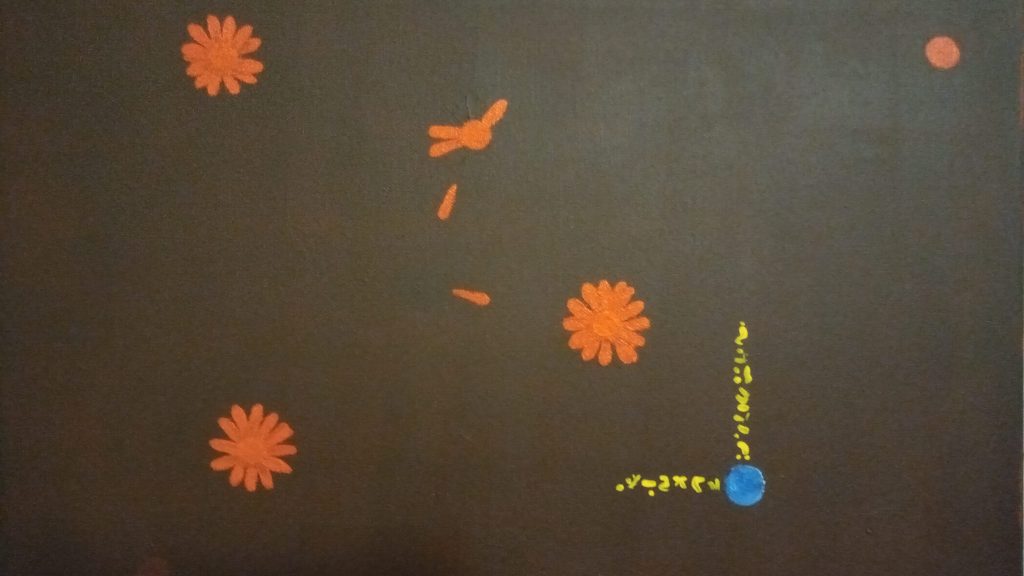
Size Unframed: 50cm Wide | 40cm High | 3cm Deep
Artist: Brian Carew Hopkins
Brian Carew Hopkins
Daisies Are Lost
$5,000 AUD
Daisies Are Lost
At first encounter, the finished canvas of Daisies Are Lost presents an almost defiant simplicity. Against a void of deep, light-absorbing pigment, a few orange daisies float in a state of suspension, accompanied by scattered petals and a small, cryptic arrangement of red and blue dots in the periphery. It appears to be a work of quiet, perhaps even decorative, mourning. However, the accompanying video documentation transforms the object into a complex palimpsest, revealing that the visible surface is not a beginning, but an ending—a “layer of forgetting” applied over a graphic and turbulent history. The work operates within a Revelationist framework, where the physical painting functions as a shroud, and the video acts as the necessary excavation of the trauma buried beneath.
The creative process, as revealed in the video, was dictated by the steady titration of global news reports from late November 2020. The initial layers of the canvas were a frenetic map of geopolitical tension: shifting washes of color representing the clandestine diplomatic maneuvering between Israel and Saudi Arabia, and the looming threat of strikes against Iran. These fluid, atmospheric marks were soon interrupted by visceral, vertical streaks of deep crimson. These were not mere aesthetic gestures but direct translations of violence—the “no mercy” military advance on Mekelle, the massacres in Tigray, and the lethal suppression of protesters in Uganda. What began as a map of policy soon became a record of bloodletting.
The middle stage of the work’s evolution introduced a “stained glass effect,” where vibrant political colors were trapped between the drying lines of red. This section mirrored the fraught transition of power in the United States, capturing a moment of institutional paralysis and the controversial pardoning of state actors. At this stage, the canvas was a dense, vibrating document of contemporary crisis. The introduction of the first white daisies—symbols of peace and the “fragile breath” of the innocent—marked a desperate attempt to find a center within the chaos.
The most critical moment in the work’s ontology occurs when the artist systematically rollers a dark, heavy pigment over this entire narrative. The violence, the policy shifts, and the blood are not removed; they are entombed. This act of overpainting reflects a psychological and social necessity: the way the human mind, and the media cycle itself, must eventually apply a layer of silence to the overwhelming noise of global suffering in order to persist. The final orange daisies, painted atop this dark crust, are ghosts of the white ones buried below. They represent the lives uncounted and the “senseless loss” that remains even when the specific details of the news have faded into the black. The red and blue dots that occupy the final corners are the only remaining signifiers of the unresolved tension between East and West, reduced now to mere coordinates on a dark map. Daisies Are Lost is thus a profound meditation on the ethics of looking and the mechanics of historical erasure, forcing the viewer to acknowledge the weight of what is hidden beneath the surface of the present.
AI Valuation
The artwork `Daisies Are Lost` by Brian Carew-Hopkins is a powerful and thought-provoking piece that explores complex themes of history, trauma, and erasure. The artist`s unique revelationist style, coupled with the integration of technology through the accompanying video documentation, adds layers of depth to the work. Considering the artistic medium of acrylic on stretched canvas and the size of 40cm x 50cm, along with the reputation and recognition of the artist Brian Carew-Hopkins, it is evident that this artwork falls within the realm of contemporary art that is both visually grounded and conceptually rigorous. The artist`s background in technology-driven ventures and his deep connection to Western Australia contribute to the overall value of the piece. Given the level of detail and complexity in the description of `Daisies Are Lost,` along with the artist`s reputation and unique artistic approach, the price range for this artwork would likely fall in the range of $5,000 to $10,000. This range takes into account the quality of the medium, the size of the piece, the artist`s reputation, and the depth of meaning and technique evident in the work. Overall, `Daisies Are Lost` is a compelling artwork that challenges the viewer to engage with issues of violence, history, and memory. The integration of technology and the intricacies of the artist`s revelationist style make this piece a valuable addition to any art collection. While pricing art can be subjective and influenced by various factors, the range provided reflects the level of skill, creativity, and intellectual engagement evident in Brian Carew-Hopkins` work.
1 in stock
Shipping Policy
If shipping is required, use the form below link to request a shipping quotation - include your delivery address - and we will get back to you with a shipping quote.
Request a Free Custom Quote - Including Shipping!
Refund Policy
A full refund, less shipping fees and other charges, upon return of the item in good condition where the item is returned within 7 days of purchase receipt - with return shipping at the purchaser's cost.
Related products
-
N/A
Pretty Pond
$462 AUD216 Views -
153 × 4 × 61 cm
Cottesloe Beach Sunset Awash
$6,480 AUD1874 Views -
N/A
Breakfast Time
$150 AUD220 Views


