




Size Unframed: 50cm Wide | 40cm High | 2cm Deep
Artist: Brian Carew Hopkins
Brian Carew Hopkins
Skulls of Madagasca
$5,000 AUD
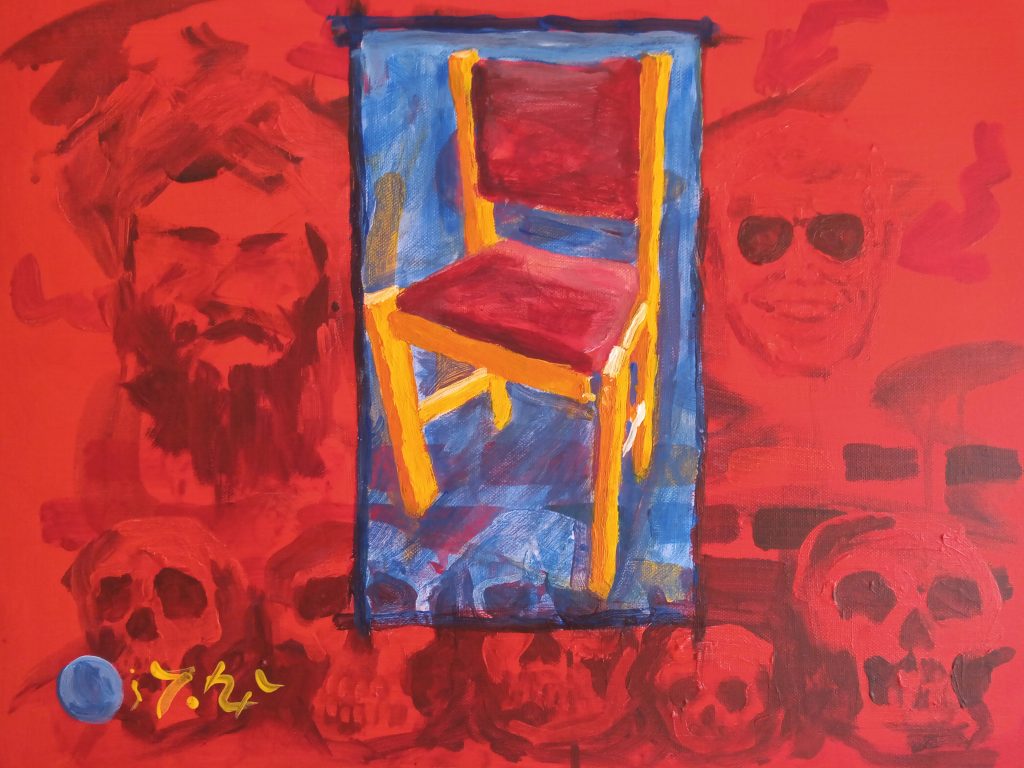
In Skulls of Madagascar, the distinction between the static image and its temporal unfolding is entirely collapsed, creating a singular Revelationist work that operates through a cycle of inscription and erasure. The final composition presents as a deceptively simple, even surrealist, tableau: a red-seated dining chair occupies a blue aperture at the center of a saturated red field, flanked by the ghostly, monochromatic visages of two men and a base of spectral skulls. Viewed in isolation, the work might be read as a meditation on domestic fragility. However, the constitutive video layer reconfigures this reading, revealing that the chair is not merely a subject, but an act of concealment—a domestic screen drawn over a landscape of geopolitical and humanitarian crisis.
The work’s internal logic is one of the palimpsest. As the piece develops, the canvas initially becomes a repository for the anxieties of a specific historical moment: the week ending September 4, 2021. The artist’s hand—embodied here by the likeness of a former architect of global policy—sketches out a chaotic iconography of decline. Blue gestures and red downward-pointing arrows evoke the volatility of global markets and the strangulation of supply chains. Beneath these, a literal wall of red bricks begins to rise, suggesting the hardening of borders or the structural collapse of infrastructure. Into this churn of data and anxiety, the “shadow” figures emerge: the bearded likeness of a Taliban leader and a grinning, sunglass-clad President Joe Biden. They stand as silent sentinels over a row of skulls that materializes at the painting’s base—a visceral citation of the famine in Southern Madagascar, where the convergence of climate change and systemic mismanagement led to the starvation of over a million people.
The conceptual pivot of the work occurs in the act of overpainting. The vibrant, chaotic record of famine and failed diplomacy is systematically suppressed. A deep blue window is carved out of the center, and upon it, the artist meticulously renders a common dining chair. The surrounding field is then flooded with a unifying, bloody red, pushing the political actors and the skulls into the periphery, where they remain only as latent, “Schrödinger-like” presences. They are visible only to those who have witnessed their birth in the video, existing in a state of permanent haunting behind the final surface.
This transformation serves as a searing critique of the Western gaze and the “Jungian shadow” of modern liberal democracy. The narration juxtaposes high-level critiques of identity politics and international relations with the banality of a broken household object. By concluding with the statement that “one of our chairs is broken,” the work equates the collapse of global stability with a minor domestic inconvenience. The chair becomes a monument to the selective blindness of the comfortable; it is the physical manifestation of the “broken” seat of power that can no longer support the weight of the world it has shaped. Skulls of Madagascar thus functions as a ritual of exposure, forcing the viewer to confront the reality that our most mundane comforts are often painted directly over the bones of the distant and the disregarded. In this Revelationist framework, the “true” artwork is neither the chair nor the skulls, but the uncomfortable knowledge of what lies beneath the red.
Notes from the artist:
News stories from the week ending 4th Sept 2021.
Markets recover despite supply chain restrictions.
Extreme left ideology is threatening liberal democracy.
Eager partners line up to court the Talabani, where is the USA.
Famine causes a million people in Madagascar into starvation.
AI Valuation
The artwork described, `Skulls of Madagascar` by artist Brian Carew-Hopkins, is a complex and layered piece that combines acrylic painting on canvas with a digital video counterpart. The artist`s reputation as a technologist and entrepreneur, as well as his innovative approach to art and technology integration, adds value to the artwork. The piece is in new condition and is being put up for sale by the artist for the first time. Given the unique nature of the artwork, its size (40cm x 50cm), and the reputation of the artist, the price range for `Skulls of Madagascar` would likely fall within the range of $5,000 to $10,000. This price range takes into consideration the artist`s background, the medium and size of the artwork, as well as the conceptual depth and complexity of the piece. Additionally, the fact that the artwork incorporates a digital video component adds to its value and could justify a higher price point. Overall, `Skulls of Madagascar` is a thought-provoking and visually striking artwork that reflects the artist`s exploration of contemporary issues and his unique Revelationist style. The integration of technology and traditional art medium, as well as the deep layers of meaning embedded in the piece, contribute to its value and justify a price range in the $5,000 to $10,000 range. Collectors and art enthusiasts who appreciate innovative approaches to art and complex, multi-layered narratives would likely find this artwork to be a compelling addition to their collection.
1 in stock
Shipping Policy
If shipping is required, use the form below link to request a shipping quotation - include your delivery address - and we will get back to you with a shipping quote.
Request a Free Custom Quote - Including Shipping!
Refund Policy
A full refund, less shipping fees and other charges, upon return of the item in good condition where the item is returned within 7 days of purchase receipt - with return shipping at the purchaser's cost.
Related products
-
N/A
Week Ending Friday 20 August 2021
$10,000 AUD60 Views -
N/A
Decision
$250 AUD1201 Views


