




Size Unframed: 40cm Wide | 30cm High | 3cm Deep
Artist: Brian Carew Hopkins
Brian Carew Hopkins
Drawer off Its Runners
$5,000 AUD
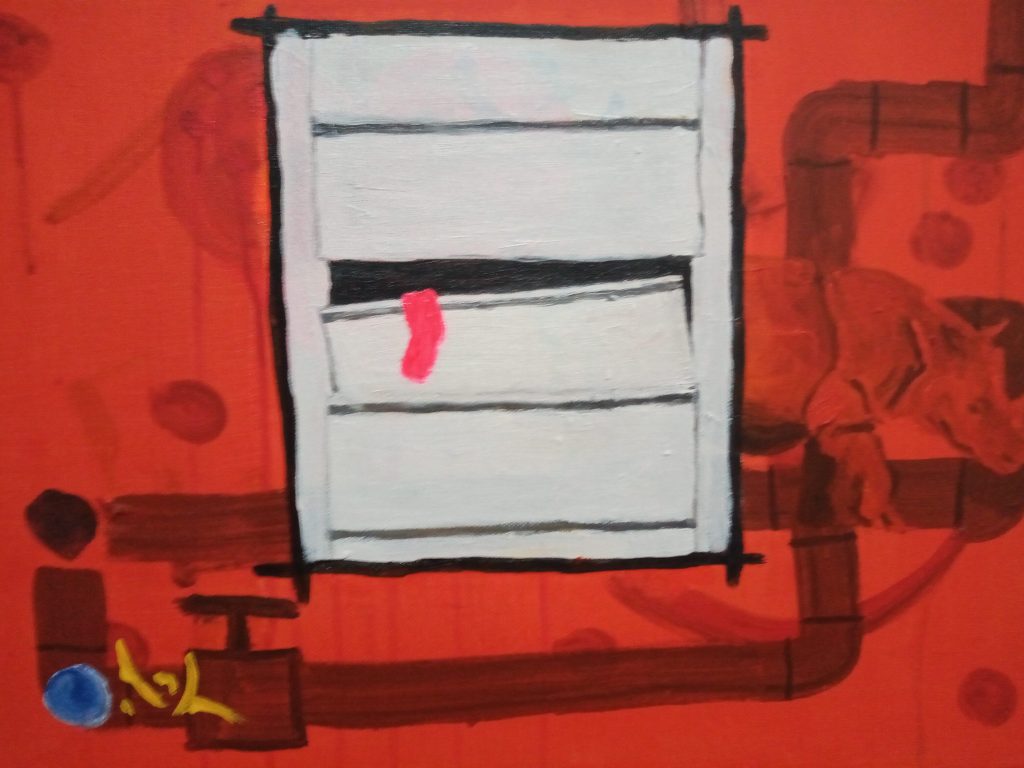
In the static image, the viewer encounters a high-contrast, surrealist composition dominated by a saturated red-orange field. Centrally, a white, rectangular form resembling a chest of drawers or a shuttered window is outlined in heavy black. A single pink shape—evoking a tongue or a stray sock—protrudes from a dark gap in the drawers. This domestic object is entangled in an industrial network of brown pipes and black valves. To the right, the translucent silhouette of a rhinoceros appears to pass through the plumbing. The palette is primary and aggressive. Spatially, the work is flat, with the white chest acting as a foreground “plug” that disrupts the background. Without the video, the work suggests a generic surrealist commentary on the encroachment of industry upon nature or the subconscious.
The video reveals that the still image is a palimpsest. The central white wardrobe is not a primary subject but an act of redaction. It functions as a literal and metaphorical “cover-up” of the three traumas established in the video: genocide (Myanmar), geopolitical energy blackmail (Russia/Germany), and ecological collapse (the rhino). The “pink sock” in the final image is revealed to be a remnant of the “red heart” painted earlier; the domestic nuisance (a broken drawer) is a trivialized mask placed over global catastrophe.
In the Revelationist framework, the wardrobe serves as the “persona”—the surface level of consciousness that prioritizes minor domestic inconveniences. The video exposes the “shadow”: the latent, repressed anxieties of global survival that exist beneath the white paint. The work mimics the collapse of a wave function; until the video is seen, the red background is merely a color choice. Post-revelation, it is reconfigured as the “blood” of the Myanmar crackdown or the “energy” of the gas pipes. The “slipping runner” of the wardrobe becomes a metaphor for the failure of the domestic mask to fully contain the overwhelming scale of global trauma.
This integrated work functions as a psychological mechanism of displacement. Through the lens of Revelationist art, the physical canvas is understood not as a finished composition, but as the final state of an active suppression.
The video component establishes a dense field of global anxieties: the systematic violence in Myanmar, the precariousness of European energy infrastructure, and the fragile interdependence of the Sumatran rhino’s ecosystem. These are not merely themes; they are the literal foundations of the painting, physically occupying the central space of the canvas. However, as the work progresses, the artist performs a violent aesthetic intervention. The “wardrobe”—a symbol of the mundane, private sphere—is painted over these crises, effectively “closeting” the trauma.
The shift in narration is the work’s conceptual fulcrum. As the global tragedies are visually buried under white paint, the voiceover pivots to a trivial complaint about a broken furniture runner. This creates a jarring juxtaposition between the magnitude of the “shadow” (extinction and war) and the insignificance of the “persona” (domestic maintenance). The final static image, viewed in isolation, appears surreal and harmless. Only through the video does the viewer realize that the white center is a void created by the refusal to look at the world. The work captures the “Schrödinger-style” state of contemporary consciousness: we are simultaneously aware of global collapse and entirely preoccupied with the “slipping runners” of our private lives.
This multi-layered work explores the tension between global trauma and domestic preoccupation. The final image presents a wardrobe entangled in industrial piping—a seemingly surrealist tableau. However, the accompanying video reveals a hidden history beneath the surface. The white drawers were painted over a red heart and a rhinoceros, symbols of geopolitical and ecological crises described in the narration.
By physically masking these symbols with a domestic object, the artist enacts the process of psychological displacement. The “revelation” occurs when the viewer realizes the central white form is an act of erasure. The work suggests that our daily lives are often constructed as a “wardrobe”—a neat, compartmentalized space used to hide the “shadow” of a world in collapse. The “slipped runner” mentioned in the audio is the point of failure where the hidden reality begins to leak back into our field of vision.
The work utilizes a process of physical and narrative redaction to demonstrate how domestic banality is used as a shroud to suppress the overwhelming shadows of global, ecological, and geopolitical trauma.
AI Valuation
Artworks that are created by established artists with a significant reputation and recognition in the art world tend to command higher prices due to the artist`s credibility and the value associated with their name. In the case of Brian Carew-Hopkins, who is not only an artist but also a technology innovator and entrepreneur, his unique artistic style and innovative approach to combining art with technology contribute to his reputation in the art world. Collectors and art enthusiasts may be willing to invest more in his artwork due to these factors. The medium and size of the artwork, in this case, 30cm x 40cm acrylic on canvas plus digital video, also play a role in determining the price range. The inclusion of a digital video component adds an interactive and multimedia aspect to the artwork, which can often increase its value. The complexity and depth of the artwork, as described in the detailed description, further contribute to its value and potential price range. Considering all these factors, the price range for an artwork by Brian Carew-Hopkins, with the described characteristics and reputation, could fall within the range of $5,000 to $15,000 or higher. Prices for works by established artists can vary widely based on the demand for their art, the complexity of the piece, and the artist`s overall career trajectory. Collectors and art buyers who are familiar with Brian Carew-Hopkins` work and appreciate his unique artistic approach may be willing to pay a premium for a piece that includes both the acrylic on canvas component and the digital video element. The innovative and thought-provoking nature of the artwork, as described in the detailed description, adds an additional layer of value for potential buyers. Overall, the price range for an artwork of this nature by an artist of Brian Carew-Hopkins` caliber would likely reflect the artist`s reputation, the medium and size of the artwork, and the complexity and depth of the piece. Prices for artworks can vary greatly in the art market, but the described characteristics suggest a price range that starts at $5,000 and could go up to $15,000 or more, depending on the specific details and demand for the piece.
1 in stock
Shipping Policy
If shipping is required, use the form below link to request a shipping quotation - include your delivery address - and we will get back to you with a shipping quote.
Request a Free Custom Quote - Including Shipping!
Refund Policy
A full refund, less shipping fees and other charges, upon return of the item in good condition where the item is returned within 7 days of purchase receipt - with return shipping at the purchaser's cost.
Related products
-
N/A
Decision
$250 AUD1201 Views -
N/A
Schrodinger’s Artist
$475 AUD136 Views -
N/A
Cosy Corner Two
$375 AUD96 Views -
N/A
Late Summer Sky
$2,500 AUD269 Views


